
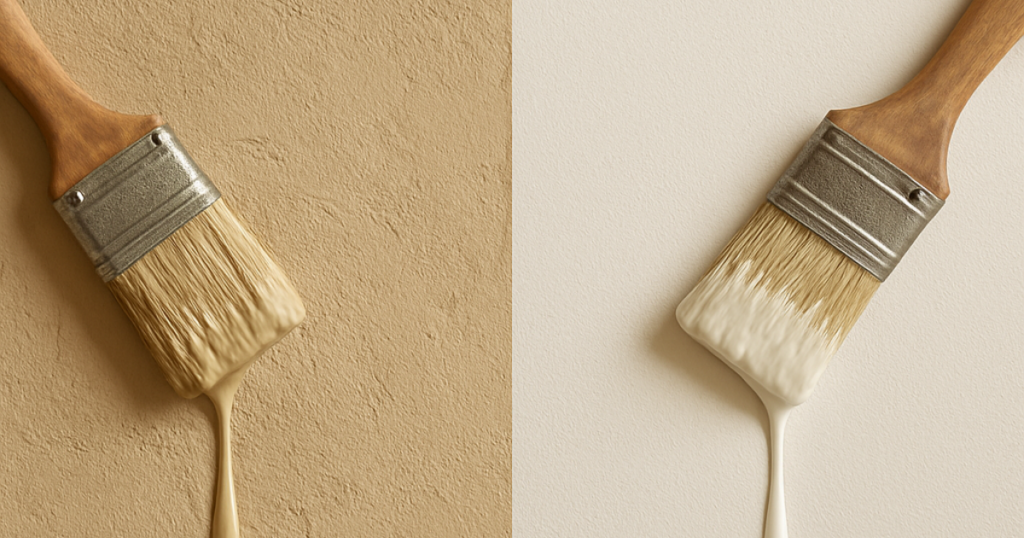
If you’re choosing a wall finish and wondering whether to go with limewash or regular paint, you’re not alone. At first glance they may seem similar — both add color to walls — but the look, feel, performance, and application are completely different.
Quick Overview
Regular paint from companies like Benjamin Moore (like latex or acrylic wall paint) create a smooth, solid, consistent color on the surface of a wall. It’s the standard finish used in most modern homes.
Limewash paint from companies like MEODED are a mineral-based finish made from crushed limestone and natural pigments. Instead of sitting heavily on top of the wall, it bonds into the surface and creates a soft, cloudy movement with natural variation.
Think of it as:
- Regular paint = uniform and polished
- Limewash = textured, breathable, and full of depth
10 Differences Between Paint and Limewash
1. Appearance: Flat Color vs Natural Movement
This is the biggest visual difference. No two limewash walls ever look exactly the same, and that’s the appeal. Instead of a “perfectly coated” wall like paint, you get something that feels layered and alive.
Regular Paint
- Even, solid color from corner to corner
- Available in multiple sheens (flat, eggshell, satin, semi-gloss, etc.)
- Looks clean, modern, and consistent
- Great for crisp, predictable results
Limewash
- Soft tonal variation with subtle highs and lows
- Matte, chalky, velvety appearance
- Creates depth and movement that changes with light
- Feels organic, old-world, and architectural
2. Texture & Feel
Regular Paint
Regular paint feels smooth to the touch, especially in higher sheens. The wall surface underneath (drywall, plaster, etc.) determines the texture more than the paint itself.
Limewash
Limewash creates a soft, mineral texture. It’s not rough like stucco, but it isn’t slick either. The finish has a subtle, powdery depth that adds character even when the color is neutral. This is why limewash is often used in:
- Feature walls
- Bedrooms
- Living rooms
- Dining rooms
3. Breathability & Wall Health
This is where limewash really separates itself.
Regular Paint
Most modern wall paints form a thin film on the surface. While durable, this film can trap some moisture inside the wall, especially in older masonry or plaster homes.
Limewash
Limewash is highly breathable. That’s one reason lime-based finishes have been used in buildings for centuries. It allows moisture vapor to pass through instead of sealing the wall. Benefits of this:
- Helps reduce trapped moisture
- Supports healthier walls in older homes
- Naturally resistant to mold and bacteria due to high pH
4. Durability & Aging
Regular Paint
- Durable against scuffs and washing (especially satin or semi-gloss)
- Easy to touch up… in theory
- Over time, may chip or peel if moisture gets behind it
- Can look worn in high-traffic areas
Limewash
With Limewash, touch-ups blend more naturally because variation is part of the finish. And it doesn’t peel like modern paint because it bonds into the surface. Instead, it ages gracefully. Over time it may:
- Soften
- Lightly patina
- Develop more character
5. Maintenance & Cleaning
If you need a super washable wall, regular paint usually wins. If you want beauty and atmosphere, limewash wins.
Regular Paint
- Easier to wipe clean, especially in higher sheens
- Good for kitchens, hallways, kids’ rooms, and bathrooms
- Stain resistance depends on paint quality and sheen
Limewash
- Best suited for lower-traffic areas
- Can be dusted or gently cleaned
- Not ideal for heavy scrubbing or constant moisture exposure
6. Application Differences
This is another major deciding factor.
Applying Regular Paint
- Roller and brush application
- Straightforward technique
- Fast coverage
- Predictable results
- Most DIYers are comfortable painting walls with standard paint.
Applying Limewash
- Applied with a large masonry or lime brush
- Uses cross-hatching or layered brush techniques
- Requires embracing variation, not fighting it
- Often applied in multiple thin coats
- Limewash is more of a decorative finish than a basic paint job. Technique matters, and the goal is movement, not uniformity.
7. Where Each Finish Works Best
Best Places for Regular Paint
- Kids’ rooms
- Hallways and stairwells
- Kitchens and bathrooms
- Rental properties
- Modern, minimalist interiors needing flat color
Best Places for Limewash
- Living rooms
- Bedrooms
- Dining rooms
- Accent walls
- Homes with natural, rustic, Mediterranean, or historic design styles
- Limewash is about mood and texture, not just color coverage.
8. Color & Finish Options
Regular Paint
- Unlimited color matching
- Wide range of sheens from matte to glossy
- Consistent, repeatable results
Limewash
- Usually matte or ultra-matte only
- Earthy, mineral-toned palette (though modern pigments expand options)
- Color appears softer and more dimensional on the wall than on a swatch
- Even bold limewash colors feel more muted and natural because of the mineral base.
9. Cost Differences
Regular Paint
- Lower material cost
- Faster labor
- Standard prep and application
Limewash
- Higher material cost than standard paint
- More labor-intensive application
- Considered a specialty decorative finish
- Homeowners see limewash as an upgrade in visual value, similar to plaster or specialty wall treatments.
10. The Overall Vibe
Sometimes the decision comes down to feeling. If you want…
- Clean, uniform, modern walls: Regular Paint
- Soft, textured, old-world character: Limewash
- Easy maintenance: Regular Paint
- Natural materials and breathability: Limewash
- Quick DIY project: Regular Paint
- Statement walls with depth: Limewash
So, is Limewash Better Than Regular Paint?
Not better or worse, just different.
Choose regular paint if you want:
✔ Easy maintenance
✔ Smooth, consistent color
✔ Faster, simpler application
Choose limewash if you want:
✔ Natural, mineral-based materials
✔ Soft movement and visual texture
✔ Breathable walls
✔ A high-end, architectural look
Visit a Loconsolo Paints store near you for more advice from our trained teams members. We carry both limewash and standard paint throughout the 5 boroughs of NYC.