
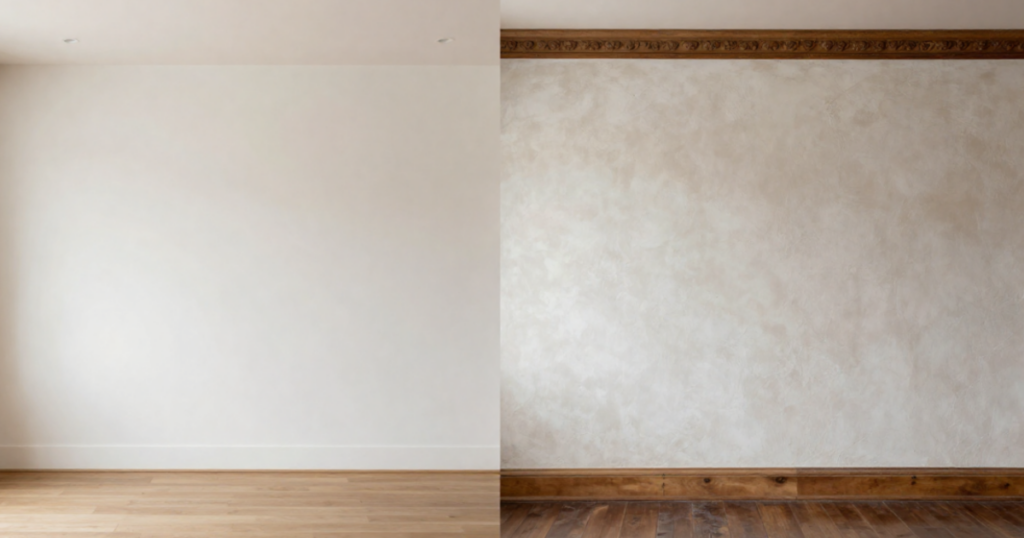
If you’re renovating or buying an older home, you’ll likely run into the question: what’s the difference between drywall and plaster walls?
While both are used to create interior walls, they are built very differently and behave differently when it comes to durability, repairs, and painting.
Understanding whether your home has drywall or plaster can help you make better decisions when it comes to renovation, patching, and paint preparation.
What is Drywall?
Drywall is the most common wall system used in modern homes. It consists of gypsum plaster pressed between two layers of paper and is installed in large sheets over wall studs.
Drywall is popular because it is:
- Quick to install
- Cost-effective
- Smooth and easy to paint
- Easy to repair in most cases
Most homes built after the mid-20th century use drywall for interior walls and ceilings.
What are Plaster Walls?
Plaster walls are more common in older homes, especially those built before the 1950s. Instead of sheets, plaster is applied in multiple layers over a lath base (wood strips or metal mesh). The result is a harder, more solid wall surface.
Plaster walls are known for:
- Durability
- Dense, solid feel
- Better sound insulation
- More complex repair process
Many older homes in areas like Queens, Brooklyn, and historic neighborhoods still have original plaster walls.
Drywall vs Plaster: Key Differences
1. Construction Method
- Drywall: Prefabricated sheets installed over studs
- Plaster: Wet material applied in layers over lath
2. Durability
- Drywall: Easier to dent or damage
- Plaster: Harder and more impact-resistant
3. Repairs
- Drywall: Easier and faster to patch
- Plaster: More labor-intensive and often requires specialized repair techniques
4. Soundproofing
- Drywall: Standard sound insulation
- Plaster: Typically better sound-dampening due to density
5. Appearance Over Time
- Drywall: Can show seams or joints if not properly finished
- Plaster: Often has a more seamless, solid look when well maintained
How to Tell If You Have Drywall or Plaster
If you’re unsure, here are a few signs:
You likely have drywall if:
- Your home was built after ~1950
- Walls sound hollow when tapped
- You see smooth seams at corners
You likely have plaster if:
- Your home is older (pre-1950)
- Walls feel dense and solid
- You notice slight unevenness or texture variation
- Nail or screw repairs are harder to patch
Painting Drywall vs Plaster Walls
Both surfaces can be painted, but preparation is different.
Drywall Painting Prep:
- Joint compound sanding
- Primer is essential on new drywall
- Smooth surface before painting
Plaster Painting Prep:
- Check for cracks or hairline damage
- Patch with plaster-compatible filler
- Prime porous or repaired areas
Plaster walls often absorb paint differently, so primer choice matters more.
Which Is Better: Drywall or Plaster?
Neither is strictly “better”—they just serve different eras of construction.
- Drywall is better for speed, cost, and modern construction
- Plaster is better for durability, density, and older home character
Many homeowners renovating older homes choose to preserve plaster because of its character and strength.
Can You Replace Plaster With Drywall?
Yes, but it is a significant renovation. Homeowners sometimes replace plaster with drywall because:
- It’s easier to repair long-term
- It reduces renovation costs
- It allows easier electrical or insulation upgrades
Drywall is common in modern homes, while plaster is often found in older, more traditional construction. Therefore, many choose to repair plaster instead of replacing it due to the original craftsmanship.
Final Thoughts
If you’re planning to paint or renovate either surface and want guidance on primers, patching, or paint selection, visit one of our New York paint stores to speak with our paint experts.