
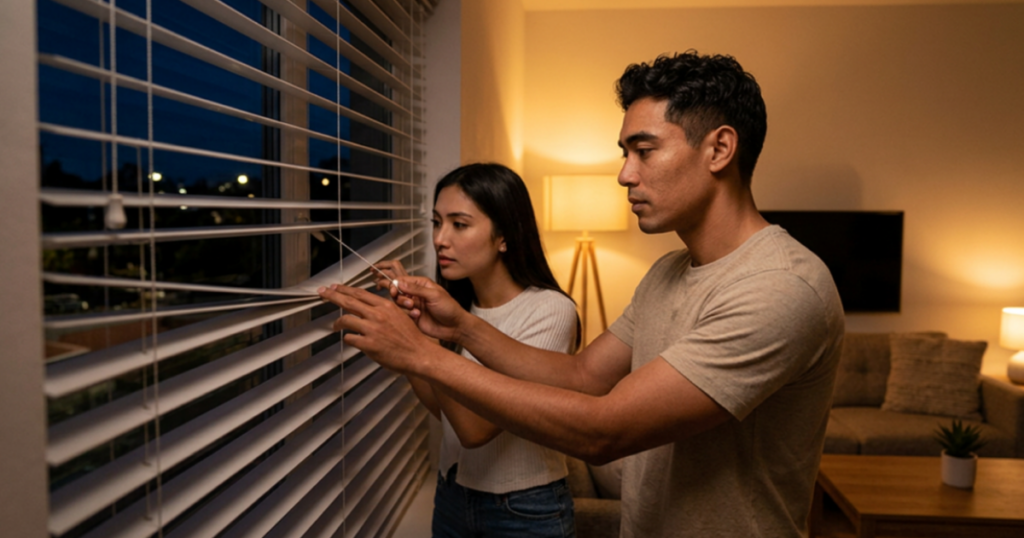
At night, blinds are generally better angled upward or fully closed for improved privacy.
When interior lights are on and it’s dark outside, visibility into your home increases significantly. The angle of your blinds can affect how easily neighbors, pedestrians, or nearby buildings can see inside.
While upward-facing blinds often provide better daytime privacy, nighttime privacy usually depends more on how completely the blinds are closed and whether additional window coverings are used.
In this guide, we’ll explain the best blind position for nighttime privacy, visibility concerns, and ways to improve privacy after dark.
Should Blinds Face Up or Down At Night?
For most homes, blinds angled upward generally provide better nighttime privacy than downward-facing blinds.
When slats angle upward:
- Visibility into the room becomes more restricted
- Light reflection may help reduce direct sightlines
- People outside have a harder angle to see through the slats
However, even properly angled blinds may still allow some visibility at night if interior lights are bright. For maximum privacy, many homeowners fully close blinds and combine them with curtains or drapes.
Are Blinds Enough Privacy At Night?
Sometimes — but not always.
At night, interior lighting makes it easier to see inside through:
- Small gaps between slats
- Partially closed blinds
- Thin materials
- Improper blind angles
This is especially noticeable in:
- First-floor apartments
- Street-facing rooms
- Homes near neighboring buildings
- Dense urban areas like Astoria or Williamsburg
If privacy is a major concern, layered window treatments often work best.
What’s the Best Way to Close Blinds At Night?
For the best nighttime privacy:
- Fully close the blinds
- Angle slats upward when possible
- Reduce strong interior lighting near windows
- Add curtains or drapes for additional coverage
- Blackout curtains or layered window treatments can significantly improve nighttime privacy while also helping block outside light.
Do Downward-Facing Blinds Reduce Light Better?
Yes — in many cases, downward-facing blinds can block direct outdoor light more effectively. However, they may also create easier sight lines from outside depending on the height and angle of nearby viewers.
This is why many people adjust blind direction differently during the day versus at night.
Are Curtains Better Than Blinds for Night Privacy?
Curtains and drapes often provide stronger nighttime privacy than blinds alone.
This is especially true for:
- Large windows
- Bedroom windows
- Ground-floor rooms
- Apartment living
Many homeowners throughout Queens and Brooklyn neighborhoods like Forest Hills and Bay Ridge use layered window treatments to balance privacy, natural light, and design.
Combining blinds with curtains often provides the best overall flexibility.
What Blinds Offer the Most Privacy?
Larger slats and poorly fitted blinds may allow more visibility from outside. Some window treatments naturally provide better nighttime privacy than others.
Popular privacy-focused options include:
- Blackout shades
- Cellular shades
- Faux wood blinds
- Roller shades
- Layered shades
Final Thoughts
For stronger nighttime privacy, many homeowners combine blinds with curtains, drapes, or blackout window treatments.
If you’re exploring blinds, shades, or custom window treatments for your home, book a FREE consultation with our interior designer today! You can also stop by our stores with window treatments too. Come by and speak with our team about window treatment options, privacy solutions, and design guidance for your space.