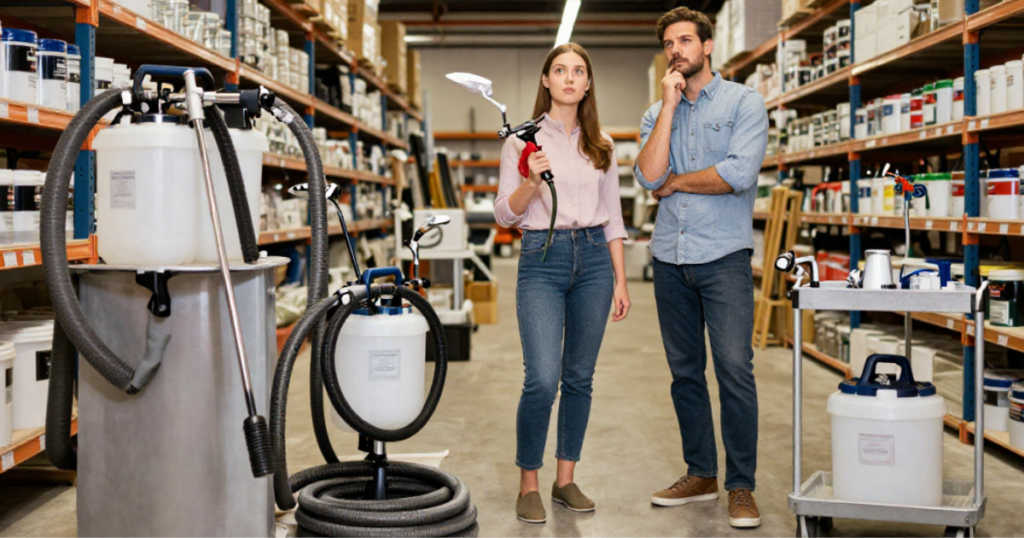
A paint sprayer is a tool that applies paint or other coatings to a surface by spraying the material through a nozzle or spray tip. Unlike brushes and rollers, which apply paint through direct contact, paint sprayers distribute coatings in a controlled spray pattern, allowing users to cover large areas quickly and achieve a smooth, consistent finish.
Paint sprayers are commonly used by professional painters, contractors, and homeowners for painting walls, ceilings, cabinets, furniture, fences, and exterior surfaces. Different types of paint sprayers are available depending on the project, coating, and desired finish.
How Does a Paint Sprayer Work?
A paint sprayer moves paint from a container through a spray gun, where it is atomized into small droplets and applied to a surface.
The exact process depends on the type of sprayer. Some machines use high fluid pressure to atomize paint, while others use compressed air or a high volume of air at relatively low pressure.
Most paint sprayer systems include several basic components:
- Pump or air supply: Provides the pressure or airflow needed to move and atomize paint.
- Spray gun: Controls when paint is released.
- Spray tip or nozzle: Determines the spray pattern and helps control the amount of paint applied.
- Paint container or suction system: Supplies paint to the machine.
- Hose: Connects the equipment to the spray gun on systems with a separate paint supply.
By controlling the spray pattern, pressure, and application technique, users can apply coatings efficiently across a variety of surfaces.
What Are the Different Types of Paint Sprayers?
There are several types of paint sprayers, each designed for different applications.
Airless Paint Sprayers
Airless paint sprayers use a high-pressure pump to force paint through a small spray tip, atomizing the coating without compressed air.
These sprayers are popular among professional painters and contractors because they can apply coatings quickly across large surfaces. Airless sprayers are commonly used for interior and exterior walls, ceilings, siding, fences, and commercial painting projects.
HVLP Paint Sprayers
HVLP stands for High Volume, Low Pressure. These sprayers use a high volume of air at relatively low pressure to atomize paint.
HVLP sprayers are often used for projects requiring greater control and detailed finishing, such as cabinets, furniture, doors, and trim. They can provide excellent finish quality when paired with the appropriate coating and application technique.
Conventional Air Spray Guns
Conventional air spray guns use compressed air to atomize paint as it exits the nozzle. These systems are commonly used for certain industrial, automotive, and specialty finishing applications.
They can produce fine finishes but may generate more overspray than some other spraying methods.
Air-Assisted Airless Paint Sprayers
Air-assisted airless sprayers combine fluid pressure with additional air at the spray gun to improve atomization. They are often used for professional finishing applications where both production speed and finish quality are important.
What Are Paint Sprayers Used For?
Paint sprayers are used for a wide range of residential, commercial, and industrial painting projects. Common applications include:
- Interior walls and ceilings: Applying paint efficiently across large surfaces.
- Exterior siding: Coating large exterior areas, including wood, metal, and compatible siding materials.
- Cabinets and furniture: Producing smooth finishes on detailed surfaces.
- Doors and trim: Applying coatings to surfaces with edges, profiles, and decorative details.
- Fences and decks: Covering broad surfaces and hard-to-reach areas.
- Commercial buildings: Painting walls, ceilings, structural components, and other large areas.
The appropriate sprayer depends on the coating being applied, the size of the project, and the level of finish required.
What Are the Benefits of Using a Paint Sprayer?
Paint sprayers offer several advantages over traditional brushes and rollers, particularly for larger projects.
- Faster Paint Application: Paint sprayers can cover large areas more quickly than brushes or rollers once the work area has been properly prepared. This makes them particularly useful for contractors working on large residential or commercial projects.
- Smooth, Consistent Finishes: When used correctly, paint sprayers can produce smooth finishes without the brush marks or roller texture associated with traditional application methods. This can be especially beneficial for cabinets, doors, furniture, and other surfaces where appearance is important.
- Better Access to Detailed Surfaces: Sprayers can apply coatings to surfaces with grooves, corners, and intricate shapes that may be difficult or time-consuming to paint with a brush or roller.
- Efficient Coverage of Large Areas: Professional paint sprayers are designed to apply coatings efficiently across large surfaces, making them useful for walls, ceilings, siding, and other extensive painting projects.
What Are the Disadvantages of Paint Sprayers?
Although paint sprayers offer many benefits, they aren’t necessarily the best choice for every project. Some disadvantages include:
- Overspray: Paint droplets can travel beyond the intended surface, requiring careful masking and protection.
- Preparation time: Surrounding surfaces often need to be covered before spraying.
- Cleaning requirements: Sprayers must be thoroughly cleaned after use to prevent clogs and equipment problems.
- Equipment costs: Professional paint sprayers generally require a larger initial investment than brushes and rollers.
- Learning curve: Proper spraying technique takes practice to achieve consistent results.
For smaller projects or spaces with extensive masking requirements, traditional painting tools may be more practical.
Is a Paint Sprayer Better Than a Roller?
A paint sprayer isn’t always better than a roller. The best option depends on the project, surface, and desired finish.
Paint sprayers are often faster for covering large, unobstructed surfaces and can produce smooth finishes without roller texture. However, rollers are generally easier to set up, require less masking, and can be more practical for smaller projects.
Paint sprayers may also use more paint because of overspray, although the amount depends on the equipment, technique, and application conditions. Professional painters sometimes combine both methods, spraying paint onto a surface and then back-rolling to achieve the desired coverage or finish.
How Do You Maintain a Paint Sprayer?
Proper maintenance helps keep a paint sprayer working efficiently and reduces the likelihood of clogs, pressure problems, and equipment failures. Basic paint sprayer maintenance includes:
- Cleaning and flushing the machine after every use
- Inspecting spray tips and filters
- Checking hoses and connections for damage
- Replacing worn seals, O-rings, and other components
- Following the manufacturer’s storage instructions
- Scheduling professional servicing when necessary
Maintenance requirements vary by sprayer type and model. Always follow the manufacturer’s instructions, including pressure-relief procedures before cleaning or inspecting equipment.
Airless sprayers operate at extremely high pressures and can cause serious injection injuries. Never place your hands near a spray tip or attempt to stop a leak with your fingers.
Paint Sprayer Repair & Service in NYC
Whether you’re a professional painter or contractor, keeping your equipment properly maintained is essential for consistent performance.
Loconsolo Paints offers professional repair, maintenance, inspections, and tune-ups for Graco and TriTech paint sprayers and spray guns at our Brooklyn location.
Call us at 718-332-1111 to discuss your equipment or ask about our repair services. You can also visit our Coney Island paint store in Brooklyn, where our paint sprayer repairs and servicing are performed.