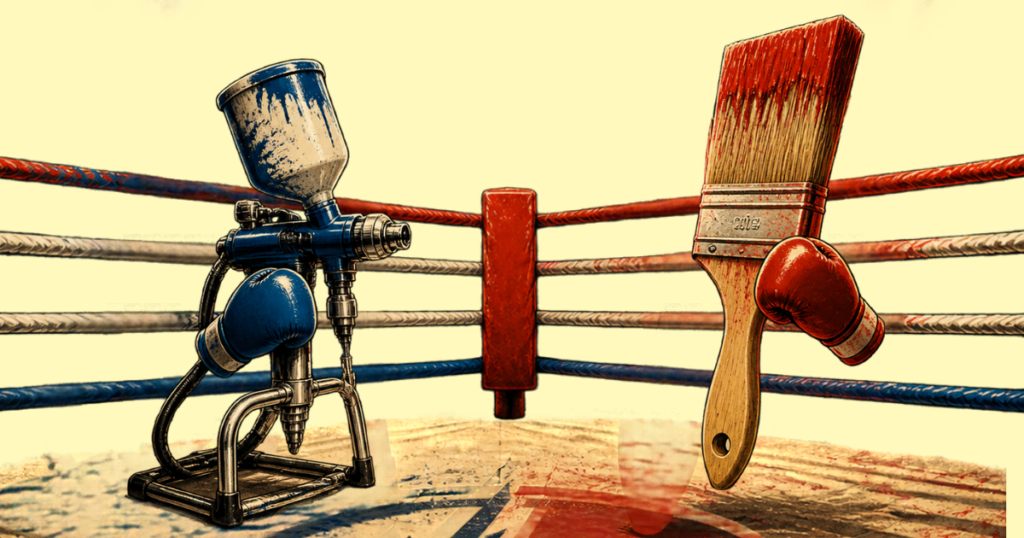
A paint sprayer is generally better for covering large surfaces quickly and achieving smooth, uniform finishes, while a paintbrush is better for small projects, detailed work, and areas requiring precise control. Both methods can produce professional results, but the right choice depends on the surface, project size, and type of paint being applied.
Paint sprayers are commonly used for walls, ceilings, cabinets, fences, and exterior siding. Brushes remain essential for cutting in, touch-ups, trim, and projects where overspray would be difficult to control.
Paint Sprayer vs. Brush: Key Differences
| Feature | Paint Sprayer | Paintbrush |
|---|---|---|
| Application speed | Faster on large surfaces | Slower on large surfaces |
| Finish | Smooth, with no brush marks | May show brush marks |
| Precision | Requires masking for sharp boundaries | Excellent for detailed control |
| Paint usage | May use more paint due to overspray | Generally less material lost to overspray |
| Preparation | More masking and equipment setup | Minimal setup |
| Cleanup | Requires equipment flushing and cleaning | Usually simpler |
| Equipment cost | Higher | Lower |
| Best applications | Large surfaces and smooth finishes | Trim, edges, touch-ups, small areas |
What are the Advantages of Using a Paint Sprayer?
Paint sprayers offer several advantages over traditional brushes, particularly for larger painting projects.
- Faster Application: Paint sprayers can apply coatings across large surfaces much faster than brushes. This makes them particularly useful for professional painters working on exterior siding, new construction, commercial spaces, and other extensive projects.
- Smooth, Consistent Finishes: A properly adjusted paint sprayer can produce smooth finishes without visible brush marks. This is especially beneficial for cabinets, doors, furniture, and other surfaces where appearance is important.
- Better Coverage on Complex Surfaces: Sprayers can efficiently coat surfaces with grooves, decorative details, and irregular shapes. Fences, shutters, and certain types of furniture are examples of projects where spraying may be more practical than brushing every individual surface.
What Are the Advantages of Using a Paintbrush?
Despite the speed of paint sprayers, brushes remain valuable tools for both professional painters and homeowners.
- Greater Precision: Paintbrushes allow painters to work carefully around corners, edges, trim, and other detailed areas. They’re especially useful when painting near surfaces that shouldn’t receive paint.
- Less Preparation: Using a brush typically requires much less masking and setup than using a sprayer. For smaller projects, this can make brushing faster overall, even if the actual paint application takes longer.
- Lower Equipment Costs: Quality paintbrushes are relatively inexpensive compared with paint sprayers. They also don’t require pumps, hoses, spray tips, or other specialized components.
- Easier Touch-Ups: Brushes are often the most convenient option for touching up small damaged areas, painting narrow trim, or making minor corrections.
Is It Better to Spray or Brush Paint on Cabinets?
Paint sprayers are often preferred for cabinet painting because they can produce smooth finishes without visible brush marks. Spraying is particularly useful for cabinet doors, drawer fronts, and detailed profiles.
However, brushing can be practical for cabinet frames, small touch-ups, or projects where spraying isn’t feasible. The final appearance also depends on surface preparation, coating selection, and application technique.
Is It Better to Spray or Brush Exterior Paint?
For large exterior surfaces, paint sprayers are generally faster and can apply coatings efficiently across siding, fences, and other broad areas.
However, brushing offers greater control around windows, doors, trim, and architectural details. Some exterior coatings or surfaces also benefit from back-brushing, which helps work paint into the substrate and achieve the coverage specified by the manufacturer.
Professional painters often combine spraying and brushing rather than relying exclusively on one method.
Does Spraying Paint Give a Better Finish Than Brushing?
Spraying can produce a smoother finish because it eliminates the direct contact between brush bristles and the painted surface. This makes it particularly useful for cabinets, doors, furniture, and other surfaces where a uniform appearance is desired.
However, a sprayed finish isn’t automatically better. Incorrect pressure, spray tips, or technique can cause runs, uneven coverage, and other defects. And high-quality brushes and properly selected coatings can also produce excellent finishes.
Does a Paint Sprayer Use More Paint Than a Brush?
Paint sprayers can use more paint than brushes because some material becomes overspray. The amount of overspray depends on the sprayer, pressure settings, spray tip, technique, and surrounding conditions.
Brushes transfer paint directly onto the surface, which can reduce material loss, although application thickness and waste still vary. For small projects, brushing is often the more economical option.
Is It Faster to Spray or Brush Paint?
Spraying is generally faster when applying paint to large, open surfaces. However, the total time required for a project includes preparation, masking, equipment setup, and cleanup.
For example, spraying an entire fence may save considerable time, while brushing a single door frame may be quicker than setting up a sprayer.
Can You Use a Paint Sprayer and Brush Together?
Yes. Professional painters frequently use paint sprayers and brushes on the same project. A contractor might spray exterior siding and then use a brush for trim, edges, or detailed areas.
Back-brushing is another common technique in which paint is sprayed onto a surface and then worked in with a brush. This may be recommended for certain coatings or substrates. Using both methods can combine the speed of spraying with the control of brushing.
Paint Sprayer vs. Brush: Which Should You Choose?
Choose a paint sprayer when you’re painting large surfaces, working with detailed shapes, or looking for a smooth finish without brush marks.
Choose a paintbrush when you’re painting small areas, cutting in around edges, completing touch-ups, or working in spaces where overspray would be difficult to manage.
For many projects, using both tools provides the best combination of efficiency and precision.
Paint Sprayer Repair & Service in NYC
If you regularly use a paint sprayer, keeping it properly maintained can help prevent equipment problems and unexpected downtime. Loconsolo Paints offers paint sprayer repair and service for Graco and TriTech paint sprayers and spray guns.
Learn more about our professional paint sprayer repair and service in NYC. Have questions? Call us at 718-332-1111 to discuss your equipment or ask about our repair and maintenance services. You can also visit our Coney Island Avenue location in Brooklyn, NY, where our paint sprayer repairs and servicing are performed.