
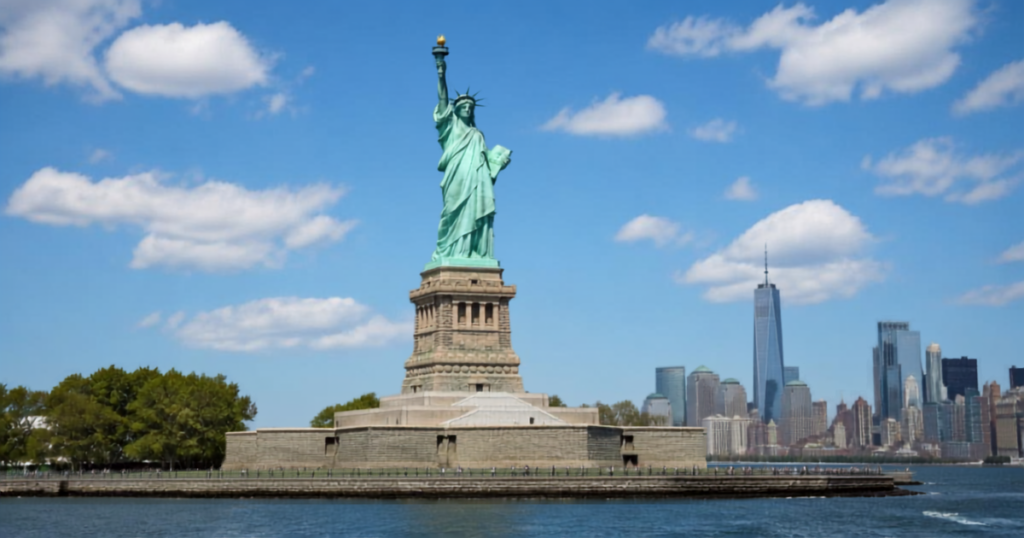
Lady Liberty is green because the Statue of Liberty’s exterior is made of copper, which naturally oxidized after years of exposure to air and moisture. This process created the familiar green coating, known as a patina, that covers the Statue today.
The Statue of Liberty wasn’t always green. When it was completed in 1886, its copper exterior had a much more traditional reddish-brown color, similar to a penny. Over the following decades, the copper gradually changed until Lady Liberty took on the green appearance we now associate with one of New York City’s most recognizable landmarks.
Why Did the Statue of Liberty Turn Green?
Copper changes when it is exposed to the environment over time. As the Statue’s copper exterior interacted with oxygen, moisture, and other elements in the atmosphere, chemical reactions occurred at the surface of the metal.
These reactions gradually formed a layer of copper compounds over the exterior. That blue-green layer is the patina we see today.
The Statue’s location in New York Harbor also exposed its copper skin to moisture and the surrounding marine environment as this transformation took place.
What Color Was the Statue of Liberty Originally?
The Statue of Liberty was originally a reddish-brown copper color rather than green. The National Park Service compares its original appearance to the brown color of an American penny.
That means someone looking across New York Harbor shortly after the Statue’s dedication in 1886 would have seen a very different-looking Lady Liberty from the one New Yorkers recognize today.
As oxidation continued, the original copper color gradually gave way to the blue-green patina.
How Long Did It Take the Statue of Liberty to Turn Green?
It didn’t happen overnight. According to the National Park Service, it took about 30 years for the Statue of Liberty to fully oxidize and form its patina.
The transformation was gradual. By 1906, the Statue had already developed a sea-green patina, and the exterior continued toward the familiar appearance it has today.
Why Doesn’t the Statue of Liberty Keep Corroding?
Interestingly, the green patina isn’t simply damage that needs to be removed. It actually helps protect the copper underneath.
The National Park Service notes that in many places the patina is as thick as the copper behind it and helps protect the copper from naturally wearing away.
So while oxidation caused Lady Liberty to change color, the resulting patina became a protective layer over the Statue’s copper exterior.
What Color is Lady Liberty?
We usually call the Statue of Liberty green, but her patina has a distinctive blue-green or greenish-blue appearance. It’s a color that has become nearly inseparable from the Statue itself.
There’s even a Benjamin Moore paint color inspired by it…
Benjamin Moore Lady Liberty 585
Benjamin Moore Lady Liberty 585 is a greenish-blue paint color inspired by the appearance of an aged patina. Benjamin Moore describes the color as capturing the distinctive shade of an elegant patina. It has an LRV of 54.7 and is part of the Benjamin Moore Classics® Color Collection.
For New Yorkers, it’s a particularly fitting color with a connection to one of the city’s most famous landmarks.
Want to see Lady Liberty 585 in person? Stop by Loconsolo Paints to view the color and compare it with other Benjamin Moore greens and blues. Visit one of our paint store NYC locations to find the right color for your next project.